
Measuring the ROI of Experience Center Design

A finance leader approving a multi-crore experience center rarely asks whether it will look impressive. They ask what it will return. That question is fair, and too often unanswered, because many organizations invest heavily in Experience Center Design without building any structure to measure whether the investment actually paid off.
What Experience Center Design Actually Needs to Justify
Experience Center Design is frequently evaluated on subjective terms: does it look premium, does it impress visitors, does it match the brand aesthetic. Those questions matter, but they are not sufficient on their own to justify the scale of investment most experience centers require.
The stronger justification ties Experience Center Design directly to business outcomes the organization already tracks elsewhere, sales cycle length, talent acquisition cost, investor conversion, or partner retention. When design decisions are made with these outcomes in mind from the start, measurement becomes possible later. When they are not, the organization is left trying to retroactively justify spend with only anecdotal praise.
Understanding Experience Center ROI Beyond Aesthetics
Experience Center ROI is the return generated relative to the capital and ongoing cost of building and operating the space, measured against concrete outcomes rather than general impressions. This includes direct financial returns, such as deals influenced or accelerated by center visits, as well as indirect returns, such as improved brand perception that shortens future sales conversations.
Calculating Experience Center ROI requires baseline data collected before the center exists, or before a redesign, so that post-launch performance has something concrete to compare against. Without that baseline, any improvement claimed afterward is difficult to attribute specifically to the space itself.
How Visitor Analytics Turns Visitor Behaviour Into Evidence
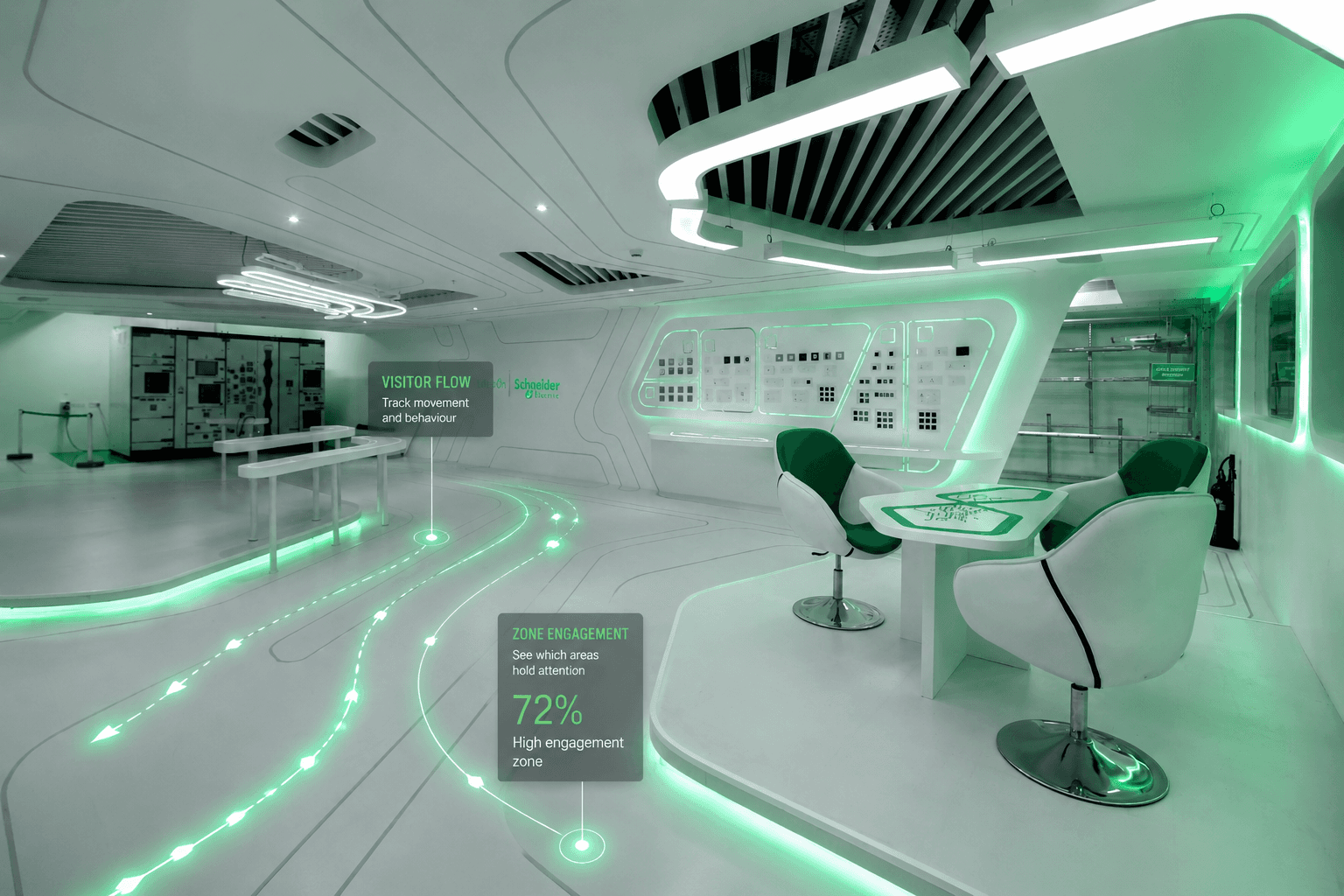
Visitor analytics captures how people actually move through and engage with an experience center: which zones hold attention longest, where visitors drop off, which interactive elements get used and which are ignored, and how dwell time correlates with later business outcomes like deal conversion.
This data replaces guesswork with evidence. A center might feel successful because tour guides report positive reactions, but visitor analytics can reveal that a key message zone is consistently skipped, or that a costly interactive installation receives minimal engagement. That kind of insight allows Experience Center Design to be refined based on actual behavior rather than assumption.
Which Business Metrics Actually Matter for an Experience Center
Business metrics worth tracking vary by the center's primary purpose, but several apply broadly: conversion rate from visit to next stage in a sales or partnership process, average sales cycle length for prospects who visited versus those who did not, talent acquisition metrics for centers focused on employer branding, and stakeholder recall rates measured through post-visit surveys.
The mistake most organizations make is tracking only visitor volume, treating footfall as the primary success indicator. Volume without conversion or recall tells very little about whether the experience actually changed how visitors think or act afterward, which is the outcome that ultimately matters.
How REDS Builds Experience Center Design Around Measurable ROI
This is the discipline REDS applies from the discovery phase onward: identifying which business metrics the center needs to move, establishing baseline visitor analytics before design begins, and building measurement into the space itself so Experience Center ROI can be tracked continuously rather than estimated after the fact.
That approach turns the experience center from a one-time capital expense into an asset the organization can continuously refine, using real visitor behavior and business outcomes to guide future updates rather than subjective opinion alone.
Frequently Asked Questions
How is Experience Center ROI calculated?
Experience Center ROI is calculated by comparing the cost of building and operating the center against measurable outcomes it influences, such as accelerated deals, improved talent acquisition, or stronger partner retention, ideally measured against a baseline collected before launch.
What is visitor analytics in an experience center context?
Visitor analytics refers to data on how people move through and engage with a space, including dwell time, drop off points, and interaction with specific content, used to understand actual behavior rather than relying on impressions alone.
Which business metrics should organizations track for an experience center?
Key business metrics include conversion rate from visit to next business stage, sales cycle length for visitors versus non-visitors, talent acquisition outcomes, and stakeholder recall of key messages after their visit.
Why is visitor volume not enough to measure success?
Visitor volume shows how many people came through the space but says nothing about whether they understood the message, retained it, or acted on it afterward, which are the outcomes that actually indicate return on investment.
Ready to Measure the ROI of Your Experience Center
If your organization cannot currently answer what your experience center returned on its investment, that gap is worth closing before the next capital cycle. REDS builds Experience Center Design around visitor analytics and business metrics from day one, so Experience Center ROI is measurable, not assumed.
Talk to REDS about building an experience center designed to prove its own value.