
The Six Lenses Every Experience Must Pass Through

Under the REDS™ Framework, every experience center, innovation lab, or corporate visitor center is evaluated through six concurrent lenses: Strategy (why the space exists), Storytelling (how the journey unfolds), Technology (how the space responds to people), Craft (what visitors touch, feel, and remember), Psychology (what reduces confusion and hesitation), and Performance (what the space changed, and how that is proven). These are not sequential design stages they are simultaneous filters applied to every decision, from the first strategy workshop to the final post-occupancy report. A design that passes only some of these lenses will look complete and still fail to perform.
A Beautiful Screen, Placed in the Wrong Moment, Is Still a Mistake
A technology vendor once proposed a striking interactive wall for the climax zone of an experience center sharp visuals, fluid gesture controls, the kind of feature that looks extraordinary in a sales deck. The material was premium. The lighting made it glow exactly as intended. Every visual instinct in the room said yes.
It was rejected anyway.
Not because it looked wrong. Because no one could answer a simpler question: what behavior does this change, and how will we know if it worked? The wall passed the lens of Craft. It never passed the lens of Strategy, or Performance. And in REDS™, passing five lenses out of six is not a partial success. It is a rejection.
This is the discipline most experience design never applies and the one that determines, quietly, whether an investment performs or simply photographs well.
Most design reviews ask one question, repeated in different forms: does this look right? Does the material feel premium. Does the lighting feel warm. Does the brand color read correctly under these fixtures. These are not unimportant questions. But answering them well, and stopping there, is exactly how organizations end up with experience centers that look finished on opening day and underperform for years afterward because no one ever tested it against anything beyond appearance.
REDS™ the Rubenius Experiential Design System asks a different question at every stage of every project: does this pass through all six lenses?
Not one. Not three. All six, simultaneously, on every decision from the choice of flooring to the placement of a single interactive screen. An experience that satisfies five lenses and fails one does not partially succeed. It fails, in a way that is often invisible until months after opening.
This is what the six lenses are, why they exist, and why removing even one collapses the entire structure.
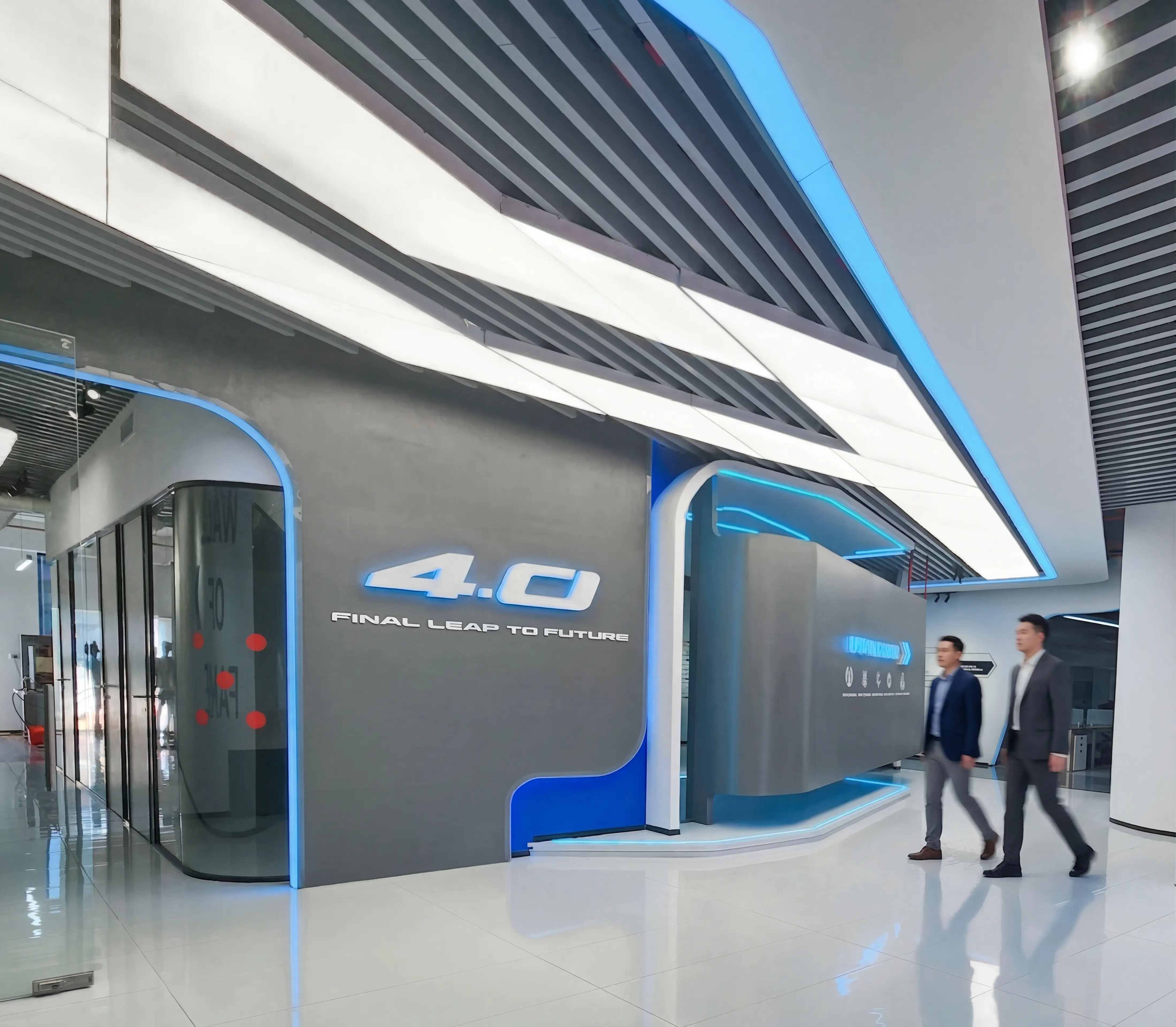
Why "Lenses" And Not "Stages"
Before walking through each one, it matters to understand what kind of framework this is because it is easy to mistake it for something simpler than it actually is.
The six lenses are not phases you move through in sequence, the way a project might progress from concept to construction. They are not departments, where one team handles strategy and hands off to another team that handles craft. They are not a checklist completed once and filed away.
They are concurrent filters. Every single decision a material choice, a piece of content, a technology specification, a wall placement must be evaluated against all six lenses at the same time, for as long as the project exists. A decision that satisfies Craft but ignores Psychology has not been properly made. A decision that nails Storytelling but cannot be measured under Performance is incomplete.
This is what separates an engineered experience from a decorated one. Decoration applies lenses one at a time, if at all pick the materials, then think about the story, then bolt on the technology, then hope it all measures up. Engineering holds all six lenses up simultaneously, against every single decision, from the very first workshop.
Remove one lens and the experience loses integrity. Not partially. Completely.
Lens One: Strategy Why Does This Space Exist, and What Must It Change?
Every experience begins with this lens, and nothing proceeds until it is satisfied.
Strategy is not a mission statement printed on a wall. It is the discipline of refusing to make a single spatial decision until the business reason for the space has been documented, interrogated, and signed off by the people accountable for the investment.
The strategic lens asks uncomfortable questions before comfortable ones. Why does this space exist beyond its functional requirements? What specific behavior, perception, or outcome must it influence? Who is this space for and, just as importantly, who is it explicitly not for? How will success be defined and measured before a single concept is drawn?
A space that passes through every other lens but skips Strategy is, by definition, decoration. It might be beautiful. It might be technologically sophisticated. It will not know what it is for and neither will the people who built it, the moment something has to be prioritized under budget pressure.
The test: if a design decision cannot be traced back to a documented business outcome, it has not yet passed through the Strategy lens. It is not ready to be approved.
Lens Two: Storytelling What Is the Story This Space Must Tell, and How Does It Unfold?
People do not experience physical space as a floor plan. They experience it as a sequence of moments, one after another, each one shaping how they interpret the next.
The Storytelling lens asks whether that sequence has been deliberately designed or simply allowed to happen. Most experience centers fail this lens silently. Zones are planned. Content is placed. But no one has actually structured the order in which a visitor is meant to encounter ideas, build understanding, and arrive at a single, intended emotional conclusion.
A space that passes through this lens has a narrative arc: a defined arrival moment that creates curiosity without overwhelming, an orientation phase that builds clarity before complexity, an engagement zone where visitors shift from passive observation to active participation, a climax that delivers the single most memorable moment of the entire visit, and a resolution that leaves visitors with a precise, intended feeling as they exit.
The test: if the core story of the space cannot be written as one clear sentence and if every zone cannot be traced back to where it sits in that story the space has not passed through the Storytelling lens. It is a collection of rooms, not a journey.
Lens Three: Technology How Does the Space Respond to Users?
This lens is where most experience centers quietly fail, because the failure is invisible at launch and only becomes obvious months later.
The question this lens asks is not "what technology should we include." It is "how does this space respond to the people inside it." That distinction matters enormously. Technology selected to impress is decoration with a power cable. Technology selected because it changes how a space behaves when a person enters, lingers, or interacts that is technology that has passed through the lens.
Every technology element must be explainable in a single sentence: what it does, and why it exists. If a screen, a sensor, or an interactive surface cannot pass that test, it has not passed through this lens regardless of how sophisticated it looks in a vendor demonstration.
Technology that passes this lens is embedded into the architecture from the outset, not mounted onto a finished space after the fact. It produces measurable data that feeds back into the Performance lens. And critically, it remains invisible exactly where invisibility serves the story and becomes the moment itself exactly where the narrative calls for it to be the feature.
The test: can every piece of technology in the space justify its existence in one sentence, tied to a specific behavioral outcome? If not, it has failed this lens no matter how advanced it is.
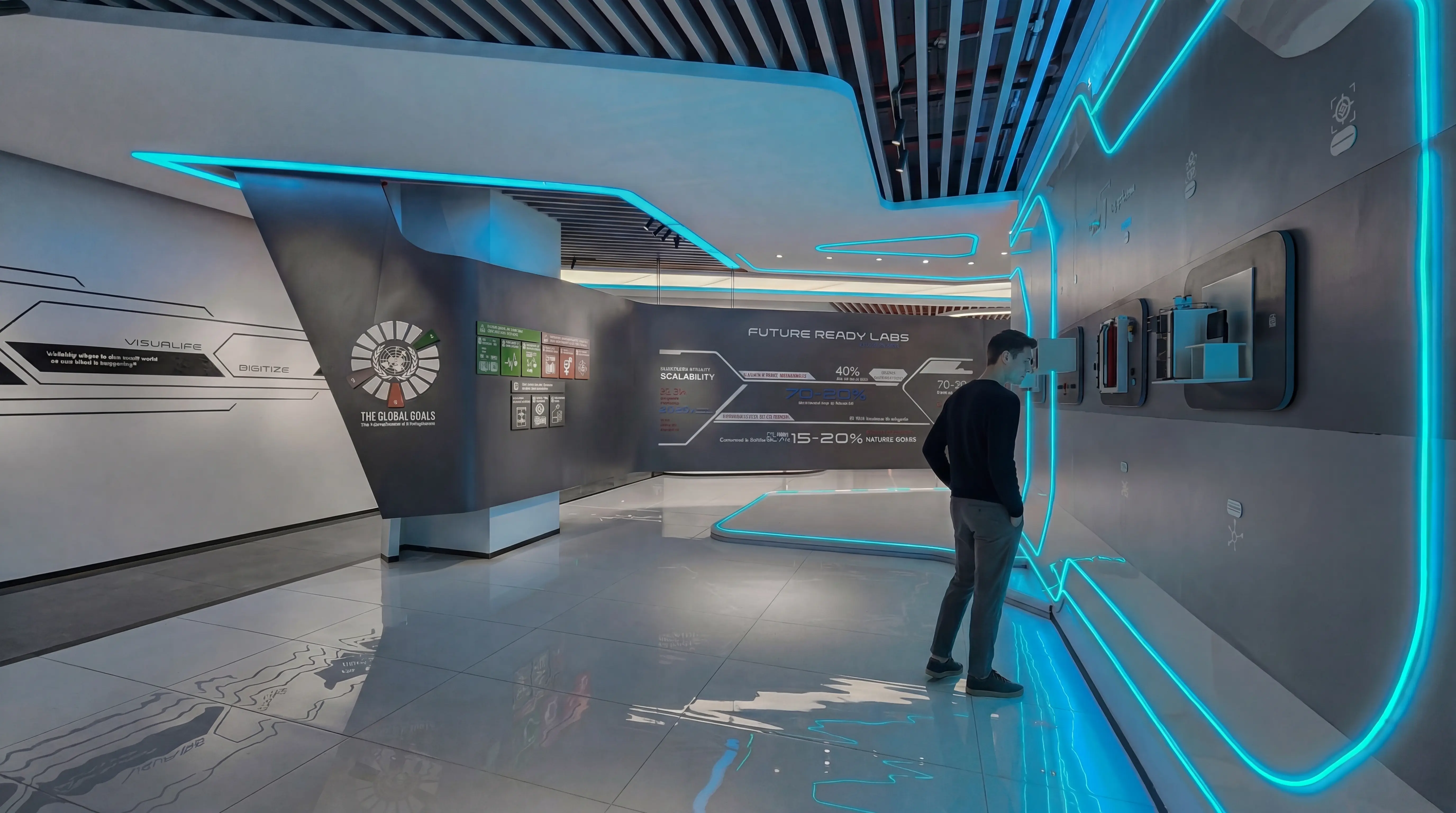
Lens Four: Craft What Do Users Touch, Feel, and Remember?
Strategy and storytelling exist on paper until craft makes them physical. This is the lens where intent either survives contact with reality or quietly dies on site.
Craft is not about specifying expensive materials. It is about precision: the temperature of a surface under a visitor's hand, the clarity of sound across a room, the consistency of finish from the most prominent zone to the most overlooked service corridor. Every joint, every seam, every material choice is part of the experience, whether a visitor consciously registers it or not.
This lens is uniquely unforgiving. A brilliant strategy and a beautifully structured narrative, delivered through inconsistent finishes or sensory discomfort, will still fail because visitors do not remember layouts. They remember how a space felt. Poor craft destroys trust before a single word of the intended story is even understood.
The test: does every material choice have a documented emotional justification warmth, trust, energy, calm or was it chosen because it looked good in a sample board? If the latter, this lens has not been passed.
Lens Five: Psychology: What Reduces Stress, Confusion, and Hesitation?
This is the lens most frequently skipped entirely, because its absence is the hardest failure to diagnose. A space that fails the Psychology lens does not look broken. It simply confuses people quietly, and everyone assumes the visitors are the problem rather than the design.
The Psychology lens demands that layout decisions follow observed human behaviour, not the behaviour a floor plan assumed at a desk. People hesitate at ambiguous decision points. They avoid complexity instinctively. They follow paths that feel intuitive, regardless of what the original circulation diagram intended.
A space that passes this lens does not require visitors to learn how to use it. Wayfinding feels unnecessary because the architecture itself guides behavior. Cognitive load is actively reduced in every orientation zone, because confusion at the wrong moment can undo everything the narrative was building toward.
The test: can a first-time visitor navigate the space confidently without asking for directions or reading instructional signage? If not, the space has not passed through the Psychology lens regardless of how clear the floor plan looked in the design review.
Lens Six: Performance: What Has the Space Changed, and How Do We Know?
This is the lens that makes every other lens accountable. It is also the one most experience centres never apply at all.
Performance asks the question that decoration is structurally incapable of answering: did this work? Not does it look like it worked. Did it actually change how visitors think, feel, behave, or perform, measured against benchmarks that were set before the design process even began?
A space that passes through Strategy, Storytelling, Technology, Craft, and Psychology but is never measured has not actually completed the process. It has simply stopped before the most important question was answered. Design that is not measured cannot be improved. And design that cannot be improved is, eventually, indistinguishable from a guess that happened to look expensive.
The Performance lens requires structured evaluation at defined intervals after launch, typically at 30, 90, and 180 days, tracking dwell time, recall, navigation ease, interaction rates, sensory comfort, brand perception shift, and return on the investment itself.
The test: is there a documented plan to measure this space's impact after it opens with named metrics, named timelines, and a named owner? If the answer is no, the project has not passed through the final, decisive lens. Everything before it was preparation for a test that was never actually administered.
Why All Six, Every Time
It would be far easier to apply these lenses selectively. Easier to nail the craft and skip the measurement. Easier to build a beautiful narrative and treat technology as an afterthought. Most of the experience design industry does exactly this and it is precisely why so many expensive spaces quietly underperform.
The six lenses only work as a system because each one checks the blind spots of the others. Strategy without Storytelling produces a space with the right intent and no way to communicate it. Storytelling without Psychology produces a beautiful narrative that confuses the people meant to experience it. Technology without Craft produces interactive moments that feel cheap the instant a visitor touches them. Craft without Performance produces a space no one can ever prove was worth the investment.
A REDS™ project applies all six, simultaneously, to every decision because an experience is not the sum of its best individual elements. It is the integrity of the whole system, tested against every lens, every time.
Frequently Asked Questions
What are the six lenses of experience design?
Under the REDS™ Framework, the six lenses are strategy, storytelling, technology, craft, psychology, and performance applied simultaneously and concurrently to every design decision, not as sequential stages.
Are the six lenses applied in order or all at once?
All at once. The six lenses are concurrent filters, not sequential phases. Every decision, from material selection to technology specification, must pass through all six simultaneously throughout the project.
What happens if a design only passes some of the six lenses?
It fails; it is not partially as a space that nails craft and storytelling but skips performance measurement, for example, and can never prove it achieved its intended outcome, undermining the entire investment.