
The REDS™ Framework: Six Pillars, Four Phases, One System for Experience Center Design

Most organisations building an experience center make the same mistake. They begin with a floor plan briefing an architect, shortlisting furniture, picking a palette, adding screens, and calling it interactive. Six months after opening, they wonder why visitors walk through without understanding the brand, why the space feels expensive but forgettable, why the investment never delivered what they expected.
The problem was never the budget. It was the absence of a system.
Why Experience Centers Need a Framework — Not Just a Brief
Experience centers, innovation labs, and corporate visitor centers are among the most strategically significant physical investments an organisation can make. They are where customers form impressions, where investors decide whether to trust, where employees understand what the organisation stands for, where global partners see, not just hear, your capabilities.
A nearly unanimous 96% of business leaders now see customer experience as a key driver of business outcomes. Yet most physical experience environments are still designed the way they were twenty years ago: aesthetics first, strategy never. The result is a category full of spaces that look impressive in photographs but fail at the one thing they were built to do: change how people think, feel, and act.
REDS™ — the Rubenius Experiential Design System exists to solve this. It is not a design style or aesthetic preference. It is a structured, repeatable, performance-driven framework that transforms physical environments into measurable expressions of brand equity, strategy, and human experience.
The Core Belief: Design Must Be Accountable
Before the pillars, before the phases REDS™ begins with one belief: a space is successful only if it changes how people think, feel, behave, or perform.
Traditional design answers one question: how does it look? REDS™ answers a different one: what does it do? This shift from aesthetics to accountability is what separates an experience center that wins deals and builds belief from one that simply occupies square footage.
Gensler's Global Workplace Survey 2024, spanning over 16,000 workers across 15 countries, found that high-performing environments must be intentionally designed for human emotion, not just function. REDS™ operationalises this insight — not as a philosophy, but as a system.
The Six Pillars
Every REDS™ project is governed by six concurrent pillars — lenses applied simultaneously across every decision, not sequential stages. Remove one and the experience loses integrity.
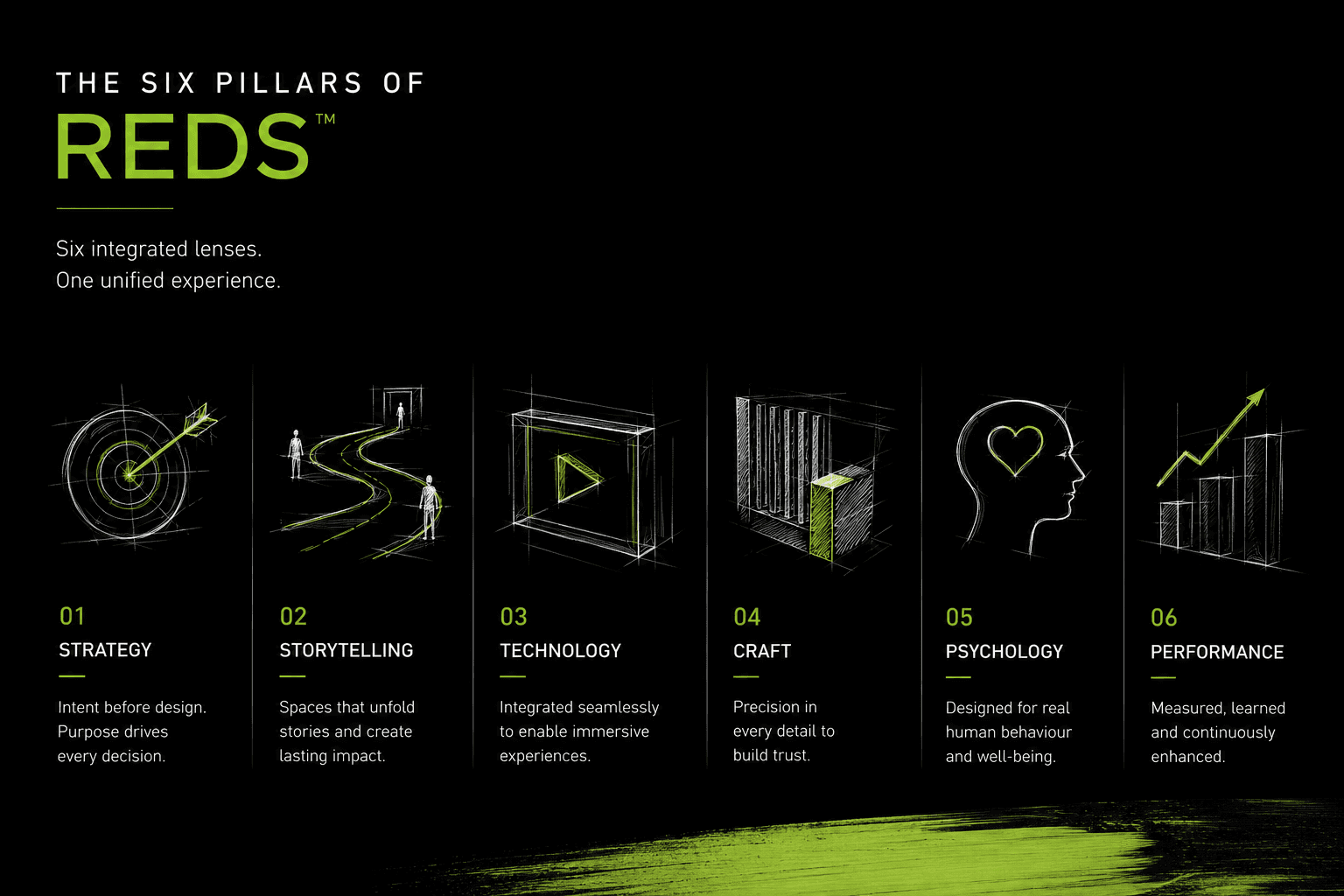
Strategy — intent before design. No project begins with form.
Every project begins with: why does this space exist, and what must it change? REDS™ requires clarity on six non-negotiable strategic questions before design begins, using tools like the Experience Brief Canvas™ and Spatial ROI Matrix™. The rule: business outcomes define design, never the reverse.
Storytelling — narrative architecture.
People experience space as a sequence of moments, not a floor plan. REDS™ structures every environment as a five-stage journey Arrival, Orientation, Engagement, Climax, Resolution using the Spatial Narrative Arc™ and Memory Anchor Framework™. The standard: a visitor should understand the core message within three minutes, without staff explanation.
Technology — infrastructure, not ornament.
Most experience centers bolt technology onto a finished design; REDS™ integrates it into the architecture from the outset. Every element must pass the Tech Integration Matrix™ explainable in one sentence, solving a defined need, producing measurable data. The principle: technology must enhance meaning, never perform for its own sake.
Craft — precision builds trust.
Design is remembered for how a space feels, not how it was drawn. The Material Emotion Matrix™ aligns every material with emotional intent; the Detail Fidelity Checklist™ ensures intent survives execution. The standard: visitors should feel the intended emotion without explanation.
Psychology — design for real behaviour.
People don't behave the way drawings predict. The Behavioural Design Map™ and Cognitive Load Index™ design for observed behavior, not assumption. The rule: a REDS™ space doesn't require users to learn how to use it — it guides them naturally.
Performance — proof over promise.
REDS™ doesn't end at handover; it ends when performance is validated. The Experience Performance Dashboard™ tracks nine core KPIs, and the POE+ framework collects data at 30, 90, and 180 days post-launch. The principle: design that isn't measured cannot improve.
The REDS Loop: Four Phases
The pillars define what is considered. The REDS Loop defines how it's delivered — four phases with mandatory sign-off gates.
Decode establishes strategy and success metrics before anything else; if Decode is weak, the project stops. Design translates strategy into narrative and spatial logic — a concept without narrative clarity is decoration with a mood board. Develop resolves every detail before site work begins; what isn't resolved here will fail on site. Deploy protects design intent through execution, with snagging tracked to closure and POE+ data collection beginning at launch.

Why This Matters Now: The India Context
This framework was built for the scale of opportunity emerging in India today. By 2025, India was home to over 1,900 GCCs, with Bengaluru alone hosting 880+ centres. India's GCC ecosystem now employs 1.9 million professionals, with revenue projected toward $100 billion by 2030.
Every one of these organisations faces the same challenge: how do you make the scale of your innovation visible? The answer isn't a better brochure; it's a better experience. Research shows 85% of consumers are more likely to engage with a brand after a direct experience, and roughly 51% of companies planned to increase experiential investment through 2026.
The Standard Has Changed
It is no longer sufficient for a space to look impressive. It must perform, communicate, and be remembered. REDS™ is the system built to meet that standard six pillars, four phases, fourteen proprietary tools, one goal: environments that change how people think, feel, and act, and prove it.
Ready to engineer an experience that performs, not just impresses? Talk to a REDS™ strategist
Frequently Asked Questions
What is an experience centre?
An experience center is a purpose-built physical environment for customers, investors, partners, or talent designed to communicate an organisation's innovation, capabilities, and culture through immersive, strategic design rather than static displays.
What is the REDS™ framework?
REDS™ is a structured, six-pillar, four-phase experiential design architecture for designing experience centers, innovation labs, and corporate visitor centers around measurable business outcomes.
How is an experience center designer different from an interior designer?
An experience center designer begins with business strategy and behavioural outcomes, while an interior designer focuses primarily on aesthetics, layout, and material selection.
Why do most experience centers underperform?
Most experience centers underperform because they are designed without defined strategy, narrative structure, or post-launch measurement looking impressive while failing to actually change visitor perception or behavior.
How long does it take to design and build an experience center?
A mid-scale experience center typically takes 8 to 14 months from strategic discovery through launch, covering Decode, Design, Develop, and Deploy phases under the REDS Loop.